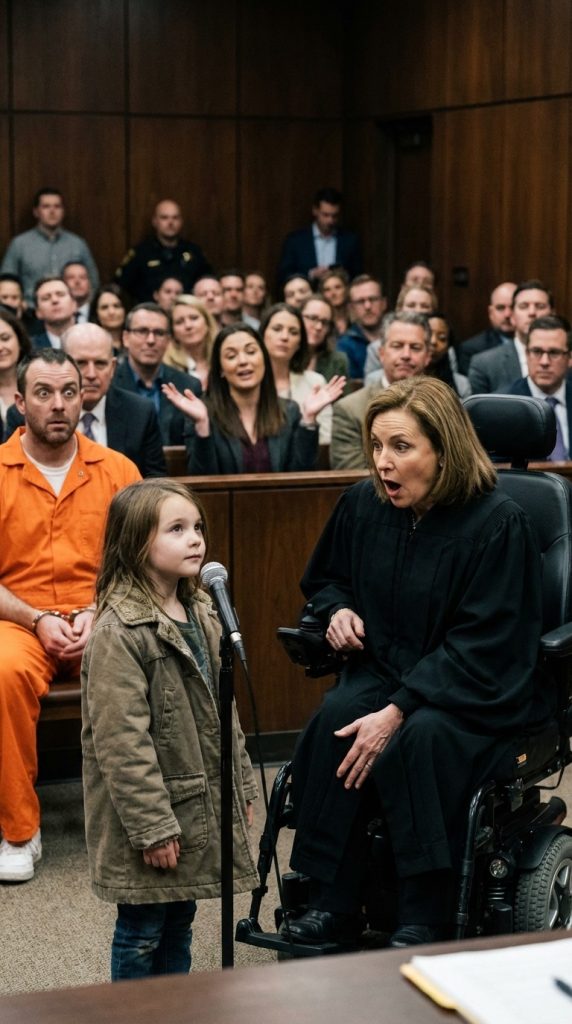
The courtroom witnessed the murder trials, corporate scandals, fierce battles for custody of children and countless lies, but on this fateful Thursday afternoon, the suffocating silence in the hall caused a child no higher than the jury, a girl in worn shoes and two uneven braids that were already unbraided, as if they were also refusing to follow the rules.
Her name was Amara Sloan and she was six years old.
Judge Chief Eleanor Whitmore presided over the state's highest criminal court for nearly fifteen years, and from the accident that weakened her legs and chained her to a stiff, black wheelchair, shining in the light of the light bulbs, she became more sharp, colder and less tolerant of sentiment. As if compensating for what she lost her body could maintain her authority only by precision. Nothing in her long career prepared her for the moment when this little child took a step forward and trembling hands, leaning against the polished wood of the bench, looked her straight in the eye and said with a voice so clear that it was heard all the way to the back wall: “If you let my dad come home with me, I promise I will help you walk again.”
The reaction was immediate and brutal in its reflex – ripped off laughter, whispered taunts, awkward shifting in chairs – because adults quickly reject things they don’t understand, especially when it threatens their sense of certainty about logic. But Eleanor Whitmore didn't laugh.
She froze.
To understand why, one must understand not only the despair of the man who was judged that day, but also the quiet, hidden inner crack of the woman who held his fate in her hands.
Three weeks earlier, Daniel Sloan could not have imagined that he would stand before the state's highest court, accused of theft, a crime punishable by five years in prison. He was, by all reasonable standards, an ordinary man, working two shifts as a technician to keep his way in a shipping warehouse, who was coming home exhausted, but nevertheless found the strength to cook for his daughter, help her read and watch at her bedside as asthma squeezed her breast like a vice and took her breath away at night.
Amara was inherently delicate, her lungs were underdeveloped, her immune system capricious, and every winter there was a silent threat of disaster hanging in the air. Daniel, however, learned to recognize the warning signs: the quiet wheezes beneath her laugh, the bluish hue around her mouth, the restless rolling from side to side in her sleep. He also learned that medications are essential for her survival.
The insurance expired a year earlier, after the warehouse was reduced and benefits were liquidated. Although Daniel worked harder than ever, he stacked pallets until his arms screamed, and repaired the machines until the grease permanently popped under his nails, the cost of specialty inhalers and steroids was too high for him to afford. When the pharmacy refused him without paying a prescription, he felt something crack in it – not violently, but with a quiet resignation, which only a parent watching a child fighting for breath can fully understand.
He told himself that he would give up that he had no choice, and when he slipped the inhaler into his jacket pocket and tried to leave without looking at anyone, he knew he had crossed a line he never imagined. But fear can narrow morality to survival.
Security guards caught him before he reached the automatic door.
The arrest took place quickly and publicly.
The allegations were serious.
And because the state recently imposed stricter sentences for theft of prescription drugs after a series of organized robberies, the prosecution was not interested in a lenient sentence, even when the defendant was a single father who stole medication for his sick child.
Judge Chief Eleanor Whitmore built her reputation on steadfast adherence to the law and from an accident that had paralyzed her three years earlier, she was clinging to that reputation as if she were the only part of her identity that is still intact. Because when her car slipped on icy ice and hit the railing, irreversibly damaging her spine, she lost more than just mobility; she lost a marriage that quietly fell apart under the weight of grief and bitterness, and lost the simple pleasure of moving without thought, without pain, without memories.
It replaced joy with discipline.
And discipline was like armor.