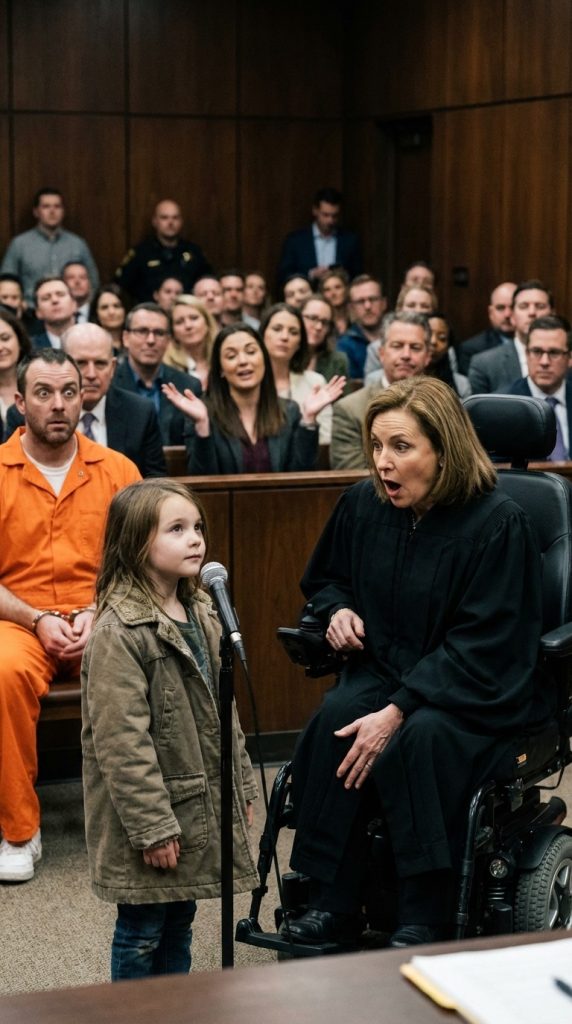
Amara came in.
She escaped from the embrace of a social worker who was about to escort her, and went by herself, ignoring the surprised reactions and warning signs of the bailiff, because the children are fearless in a way that the adults have forgotten. When she got to the bench, she didn't cry, she didn't beg, she wouldn't scream.
She made an offer.
“I can fix your legs,” she said simply, as if she promised to share a toy.
The prosecutor, deputy federal prosecutor Marcus Hale, snorted loudly and muttered something about theatrical gestures, but Eleanor felt a disturbingly foreign feeling in her chest, not so much hope as recognition. As Amara's petty hand touched the edge of the bench, Eleanor felt a fleeting feeling, the warmth that flowed along her shoulder, a feeling she had rejected as a figment of imagination but which she could not completely ignore.
"Girl," Eleanor replied cautiously, remaining calm, "medicine doesn't work that way."
Amara tilted her head and looked at the referee with ominous focus. "Sometimes the heart stops listening before it does," she said. “Maybe yours is just tired.”
A wave of anxiety swept through the room.
Eleanor didn't tell anyone about her exhaustion, not even her physiotherapist, but the child's words sounded disturbingly precise.
Contrary to all odds, the prosecutor’s objections, contrary to the court label, contrary to her own rigid rules, Eleanor postponed the judgment by thirty days.
If Daniel Sloan had complied with the law at the time, she would have reconsidered the seriousness of the allegations.
Amara thought she had made a not-so-deal.
But it was a slightly open door.
And the door, once open, can change everything.
The next afternoon, Eleanor did something she hadn't done in years: she went outside without a plan, no clues, out of sheer curiosity.
She met Amara at Riverside Park.
The little girl didn't treat her like a judge.
She treated her like a human.
They fed the pigeons.
They talked about dragon-shaped clouds.
They laughed when the wind blew Eleanor's hair into her eyes.
And although Eleanor didn't notice it right away, something about her started to melt, not dramatically, not fireworks, but a silent crackling of ice crackling on the surface of a long-frozen lake.
They met regularly for another two weeks.
Amara never tried to do miracles.
She was just telling stories.
Stories about gardens where broken branches grew stronger.
The stories of birds that have forgotten that they can fly until someone reminds them of it.
Stories about how fear diminishes when we share it.
Eleanor slept better.
After months of neglect, she began physiotherapy again.
She smiled in the courtroom.
And then, on the seventeenth day, everything fell apart.
The paving journalist discovered the surveillance footage of the pharmacy on which Daniel puts the inhaler in his pocket, and the headline that appeared in local newspapers read: "The judge shows bias in the case of the robbery - Emotional manipulation in court?"
Social outrage was immediate.
The attorney general requested an explanation.
Marcus Hale has filed a motion to resume proceedings immediately, accusing Eleanor of jeopardizing the integrity of the judiciary.
Under pressure, Eleanor scheduled an urgent hearing.
The courtroom was full again.
This time the atmosphere was hostile.
Amara was clinging to her father's hand.
Marcus Hale presented his argument with precision and precision, arguing that emotional theatricality had delayed the trial and the defendant had pleaded guilty, making further delay unjustified.
Eleanor listened.