And then she did something that no one expected.
She asked for original medical records from the night of Daniel's arrest.
There was confusion in the room.
The pharmacy records showed that the inhaler was mistakenly classified by the insurance company as defective due to a writing error; Daniel's insurance did not expire, but was improperly processed.
He was denied the release of the medication he was entitled to.
There was silence.
Marcus Hale's pale.
The theft was now, legally speaking, linked to administrative negligence.
But the real twist came moments later when Marcus admitted during the hearing that he was a member of a task force that pressured the pharmacies to refuse to implement some of the repetitive prescriptions until the fraud investigation was completed -- that policy caused exactly that delay that put Amara in danger.
The courtroom has changed its face.
The story turned out differently.
Daniel was not a criminal exploiting loopholes.
He was a father abandoned by a system that puts appearances above urgency.
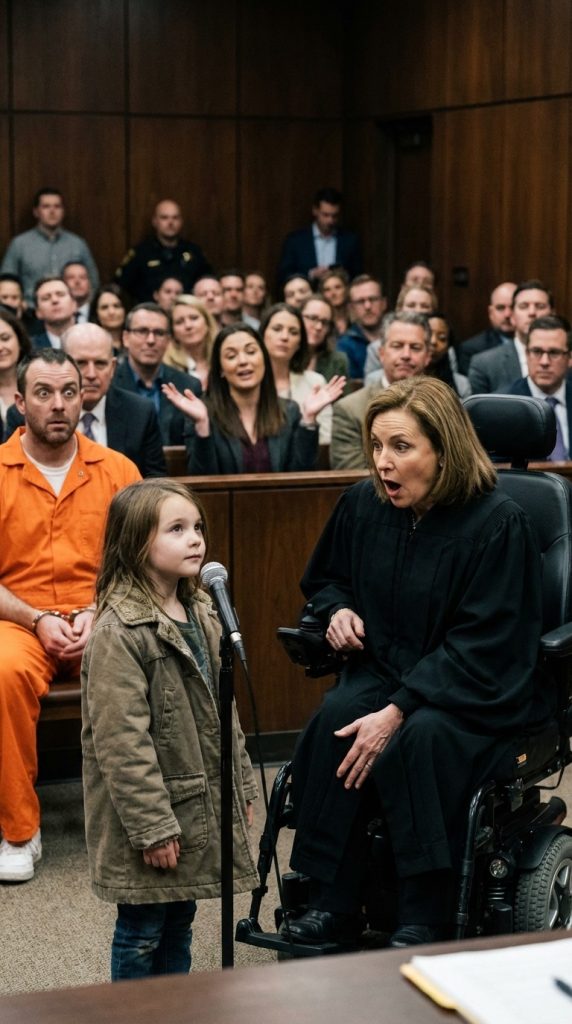
Eleanor leaned forward in the chair.
“Justice,” she said, and her voice echoed through the courtroom – “this is not a punishment detached from the context. It's a responsibility, based on truth.'
She denied any accusations.
And then, in the tense silence that collapsed, something even more extraordinary happened.
Eleanor was clinging to the edge of the bench.
She felt it again – it’s the tingling heat that enveloped her that afternoon in the park.
Her physiotherapist, who was at the gallery, instinctively stood up.
Slowly and thoughtfully, Eleanor pushed herself away, pressing herself into her arms.
Her legs were trembling.
The courtroom watched, holding her breath.
She's up.
Not completely, not elegantly, but flawlessly.
There was a surprise in the room.
Amara instinctively took a step forward, raising her hands above the ground, but not touching her.
“You remembered,” the girl whispered.
Eleanor's eyes were filled with tears.
Years of suppressed grief have been revealed.
Her paralysis was medically real, but she was deepened by trauma, fear and the quiet belief that movement meant vulnerability. Within weeks of meeting Amara, she unknowingly began treating the part of herself that she had given up.
Was it a miracle?
Was it a neurological reactivation, supported by re-therapy and an emotional breakthrough?
Experts will discuss this.
But in this courtroom, it wasn't about the mechanism, it was about the transformation.
Eleanor Whitmore took two trembling steps.
There was a round of applause.
Marcus Hale looked down.
Daniel took his daughter in his arms.
Amara just smiled as if the result had never been questionable.
Months later, Eleanor, with help, began to walk; progress was slow but undeniable. She set up a medical aid fund so that no parent would have to endure the same despair as Daniel. Marcus Hale quietly resigned during the procedural misconduct investigation, Daniel got a steady job through contacts that Eleanor provided him with, and Amara returned to school as an ordinary child who still believed that extraordinary things were possible.
The real miracle, however, was not to activate nerves or react muscles.
At this point, the authority chose empathy without losing sight of honesty.
It was the realization that justice and compassion are not opposites.
They're partners.
And sometimes it takes a child, unfettered by cynicism, to remind those who have power that strength does not come from rigidity, but from the courage to feel.
Lesson
Not every systemic defect is visible at first glance, and not every damaged body is irreversible. But when fear dictates decisions, the damage multiplies. And when courage and compassion guide action, healing begins in a way that logic itself cannot predict; justice without empathy becomes cruelty, and empathy without responsibility leads to chaos. But when these two factors are in balance, miracles—emotional, systemic, or physical—become possible, and perhaps the greatest miracle of all, is a reminder that behind every case there is a human story worth hearing before a judgment.
ADVERTISING